
Launched in 2019, Ilara Health brings affordable diagnostics to primary care settings across Kenya. The company provides artificial intelligence (AI) and tech-powered diagnostic equipment to medical facilities at a fraction of the normal cost. Doctors pay only 10-20% upfront and financing partners cover 80-90% via loans. Tests done using their devices are completed in the doctor’s office with results available in less than 10 minutes. Their software links diagnostic devices with an electronic medical record (EMR) system that records all patient data. It also sends customized health tips and reminders to patients based on their condition.
Their solutions are designed to have benefits for both medical providers and patients. Medical providers are able to provide quality healthcare with faster turnaround times while receiving increased revenue, while patients are able to access quality healthcare and receive their results quickly at lower costs.
Legacy diagnostic tools are expensive, require significant specialist expertise to operate and, as a result, have struggled to penetrate primary care settings in Kenya. The result? Only a handful of the over 15,000 clinics across Kenya can offer life-saving diagnostics, with the vast majority referring patients away to larger, congested, and distant hospitals. This drastically reduces diagnostic coverage across the country, with millions of patients receiving the tests they need too late, if at all.
Ilara Health leverages developments in point-of-care diagnostic technology, coupling next-generation, affordable and tech-enabled diagnostic tools with smart financing packages. Primary care centres can now sustainably offer diagnostic services, ranging from ultrasound services all the way to diabetic screens, directly to their communities.
The COVID-19 treatment wing at St Paul’s Hospital Millennium Medical College (SPHMMC) in Addis Ababa is saving thousands of Ethiopian Birr’s every day by reusing N95 masks. This thanks to Simbona Africa, a medical device Startup based at Jimma University in Jimma city, 300 kilometers south of Addis Ababa. Simbona has manufactured a decontamination cabinet that uses ultraviolet light (UVC) to kill coronaviruses. Studies show that 99.9% of coronaviruses are killed when exposed to UVC light[1].
With upwards of 110,000 confirmed cases and 1,700 fatalities as of November 30, Ethiopia like many countries is faced with a shortage of personal protective equipment (PPE). Moreover, the country has a critical health worker shortage with only 0.96 health workers per 1000 of the population. This falls below the African average of 2.2 per 1000 and, is five times less than the minimum requirement of 4.45 per 1000 set by the World Health Organization to achieve the SGD health targets[2]. Considering that frontline health workers face as much as three times the risk of admission with COVID as the normal population[3], the need to ensure their safety is paramount.
Dr Abdu Adem knows this only too well. As a Clinical Oncologist at SPHMMC, Dr. Abdu previously focused mainly on treating cancer patients. Following the pandemic, he is now also in charge of infection control and safety, a role he takes very seriously. COVID-19 has taken a heavy toll on patients with pre-existing conditions. With cancer patients on one side and health workers on the other, he cannot afford to take any chances. However, he is faced with an additional challenge. The demand for PPE to keep his colleagues and patients safe heavily outstrips the resources available.
Habtamu Abafoge and his team at Simbona Africa are helping to solve this problem. Habtamu’s training as a biomedical engineer at Jimma University equipped him with just the skills needed for such a situation; applying engineering principles to solve medical problems. After his studies, he founded Simbona Africa, the vehicle he would use to take his products to market. He has since built a phototherapy device to treat new-born jaundice and, an infant warmer to treat new-born hypothermia. These devices have been tested successfully and are awaiting market approval before they can be mass-produced.

Dr. Abdu has developed an elaborate standard operating procedure and trained his team to avoid the risks arising from re-using masks. Hospital staff deposit used masks in bags provided at the doffing area where PPE’s are removed. All the masks are coded with a user identifying code and tagged to track the number of use cycles. They are transferred to the UV room where the team -dressed in PPE- ensures the availability of sanitary plastic bags coded to correspond to each mask. They inspect each mask for physical damage and then place it in the cabinet for decontamination. After decontamination, the masks are inspected again for physical integrity then placed into transparent sanitary bags. Staff are then notified to collect their now sterile masks from the hospital pharmacy. Staff whose masks have been reused for 10 cycles are issued with new masks. The user-code is retained. During a tour to demonstrate this process, Dr Abdu said, ‘the UVC cabinet is easy to use and it has relieved the shortage of PPE’s which was a big headache for us.’
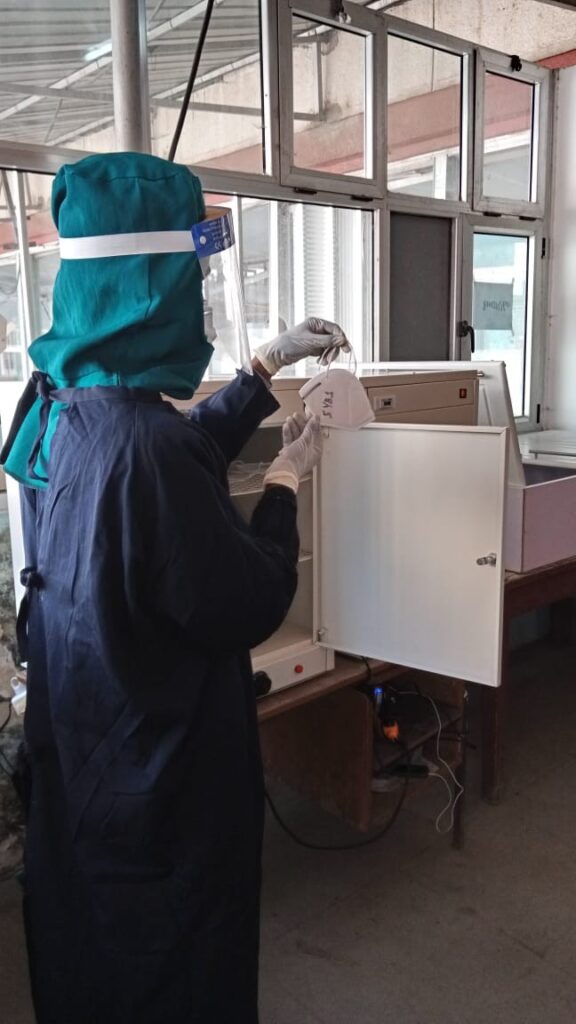

The business partnership between Simbona Africa and SPHMMC is improving efficiency at this government-owned facility. It is enabling health workers to stay safe, keep their patients safe, and deliver the best level of care possible with the resources they have available. It is a great example of the role of market-based innovations in addressing health system challenges.
Habtamu has since moved into a new office in the Dembel city centre area of Addis Ababa. In addition to device sales, he is now also offering decontamination services using his room sterilizers. His alma mater, Jimma University was his first client. They have contracted him to sanitize 500 lecture and dorm rooms. He will need to employ and train staff for this job. This is increasingly pushing him beyond his comfort zone in the lab as an engineer, towards the market as a social entrepreneur. Villgro Africa is walking him through this process. In addition to funding, he is also receiving business coaching, market-readiness support, and connections to help him establish go-to-market partnerships.
Written by Mr. Moses Waweru – Senior Program Manager – Villgro Africa
We appreciate the overwhelming support and time you took to celebrate the unveiling of Villgro Africa with us. This issue of the Villgro Africa Newsletter features a special highlight video for your future reference, an insightful episode of our podcast alongside exciting portfolio updates.

“As we look into the future, the tailwinds are now on our side to scale our impact across the African continent. In the next 5 years, we will be scaling deep, scaling wide, and scaling equitably. Part of scaling broad will be taking on a bold initiative to collaborate with local and regional hubs in joint incubation initiatives while scaling wide will be deepening the level of support offered to enterprises.” ~ Wilfred Njagi, Villgro Africa CEO
View the Villgro Africa Launch Highlights

In the second episode of a three part series on Fundraising: Demystifying the local vs expat founder funding gap, we host James Copple, (Founder of Strategic Applications International (SAI) and Servant Forge) and Chrispinus Onyancha, (Founder of a Ugandan-based health-tech startup clinicPesa) – on the role of team dynamics in fundraising. They bring together their opinions on whether Ivy-League networks help in fundraising and how founders can set Big Hairy Audacious Goals for the team to follow. Listen to the Podcast
Ilara Health Awarded $1.1M Grant by Bill & Melinda Gates Foundation
Ilara Health, a health tech enterprise that provides point of care diagnostic testing to small primary care clinics in Kenya, has received a $1.1 million grant from the Bill & Melinda Gates Foundation.
The grant will be used to improve maternal health outcomes in Kenya by developing effective antenatal care (ANC) interventions and tech-based solutions for pregnant women unable to access essential services during the COVID-19 pandemic. Read More
MamaOpe Recognised as one of the 100 Meaningful Businesses in 2020
We are delighted for Olivia Koburongo, CEO of MamaOpe, to have been recognized as one of the Meaningful Businesses 100 this year. The award celebrates business leaders across the world combining profit and purpose to help achieve the United Nations Sustainable Development Goals. Read More
The Eastern Africa Bioeconomy Conference
The Villgro Africa team had the opportunity of participating at the 1st East African Bioeconomy Conference. The regional conference, under the auspices of the BioInnovate Africa Programme, brought together scientists, technologists, and innovators from academia, public, and private sector to network and share their experiences of bioeconomy development in Africa, including appropriate enabling environment to foster its growth. The team did due diligence on an array of bioinnovations from the region which were showcased at the conference in a bid to attract new investment opportunities. Villgro Africa will work closely with BioInnovate Africa to deliver a 4-day Bioscience Innovation Bootcamp for the Innovators from the programme.
As we announced at our launch on October 29th 2020, Villgro Kenya will now serve the entire continent as Villgro Africa. We are excited about the future, but are also taking the time to reflect on our past, celebrating our victories and milestones and examining what makes us unique as an organisation.
Villgro is an early stage business incubator and impact investor that seeks to support start-ups with a global health impact in Africa. Working at the intersection of science and industry, Villgro Africa is pioneering social entrepreneurship and impact investment in healthcare and life sciences. The challenge is not in the lack of technology or know-how to solve these problems, but the lack of a convincing business case to warrant the effort. We work with entrepreneurs to develop and deliver innovative solutions through a market-driven approach that targets Africa’s mass market.
We believe that Africa’s development problems will be sustainably resolved through for-profit, innovative products and business models that are demand-driven and scalable. Such enterprises deliver social impact by creating jobs for Africa’s rural and urban poor or by meeting their needs as the target market.
We pride ourselves in being a pioneer health business incubator in East Africa. We now look forward to expanding this to the entire continent. Our incubation plan is custom designed for each enterprise based on their needs at their current stage. We work with entrepreneurs to help them become ready for investment. We expect the investable enterprises to scale up their social impact as they grow after incubation.
Our strength is in healthcare and life sciences. This cuts across many sectors such as primary healthcare, mother and child health (MCH), non-communicable diseases (NCD), nutrition in agriculture, water and sanitation in environmental management, or safety and ergonomics in design of tools and products across various industries. We provide high-touch mentorship by connecting incubatees with mentors who bring with them years of experience in the industry and entrepreneurship
We are delighted for Olivia Koburongo CEO of MamaOpe to have been recognized as one of the Meaningful Businesses 100 this year. The award celebrates business leaders across the world combining profit and purpose to help achieve the United Nations Sustainable Development Goals.
There are 120 million episodes of pneumonia per year globally in children under 5, over 10% of these progress to severe episodes (WHO, 2016 factsheet). Pneumonia is the world’s leading cause of death among children under 5 years of age, accounting for 16% of deaths.
MamaOpe easy to use and time-saving kit that can aid health workers and practitioners to easily diagnose Pneumonia at a faster rate with increased accuracy.
The 2nd edition of the MB100 was curated by an expert panel of 16 judges, following a global nomination process. The platform received over 500 nominations from 70 countries, with each one scored across 5 key areas: Impact, Leadership, Innovation, Durability and Scope.
The 100 business leaders include corporate CEOs, entrepreneurs, micro-entrepreneurs, sustainability leaders, functional heads and impact investors from 34 countries. Industries that dominate the list include agriculture, education, healthcare and technology.
Commenting on the MB100, Tom Lytton-Dickie, Founder and CEO, Meaningful Business said, “We are delighted to recognise SEP Jordan as part of the Meaningful Business 100 for 2020. In what has been a challenging year for everyone, the MB100 provides an inspiring reminder of the brilliant work being done around the world to solve the biggest issues we are facing today.”
View the full 2020 MB100 here: meaningful.business/mb100-2020/