
For communities in rural Zimbabwe, accessing healthcare can mean travelling long distances, shortages of healthcare professionals and limited access to health infrastructure.
ZimSmart Villages is working to close that gap.
The Zimbabwean digital health venture is using technology to connect underserved communities with healthcare professionals and services. Its model, based on telehealth kiosks and community-based digital health ambassadors, is bringing healthcare closer to people who might otherwise struggle to access it.
ZimSmart Villages is part of The Fred Hollows Foundation Eye Health Accelerator, carried out in collaboration with Villgro Africa. Villgro Africa has been strengthening the business and building the systems needed to grow its impact. Its broader approach to healthcare access also offers a pathway for services such as eye screening and care to reach communities through digitally enabled primary healthcare.
For Co-founder and Chief Operating Officer Tawanda Njerere, the challenge ZimSmart Villages is addressing comes down to access. Across rural Zimbabwe, distance and shortages of healthcare professionals can make accessing care difficult. ZimSmart Villages is using digital health to help bridge that gap.
Its telehealth kiosks enable rural communities to access doctor consultations facilitated by nurses, alongside other healthcare services. The venture has also introduced digital health ambassadors who travel into communities by bicycle with portable Starlink connectivity, tablets, diagnostic tools and essential medicines, bringing screenings and virtual consultations closer to people’s homes.
ZimSmart Villages has established 19 operational telehealth kiosks, facilitated more than 23,000 consultations and dispensed more than 56,000 prescriptions through its ecosystem.
Getting to this point required the ZimSmart team to rethink its original approach. ZimSmart Villages initially planned to provide services through an online platform. But the team quickly encountered a reality familiar to many innovators: the solution they had designed did not fully match the context in which people would use it. Some intended users did not have smartphones or reliable internet access, while others were unfamiliar with the technology. The team responded by developing physical telehealth kiosks and, later, taking services even closer to households through its digital health ambassadors.
“We celebrate our failures as much as we celebrate our successes, because we have taken every failure as a learning point that has helped us improve the model that we deliver to the communities,” Tawanda says.
The challenge is now different: how to meet growing demand and reach more communities while maintaining the quality of care and building a financially sustainable model.
For Co-founder and Chief Medical Officer Dr. Admore Jokwiro, the motivation to build ZimSmart Villages grew from years of working within Zimbabwe’s public health system.
Earlier in his career, Admore served as a district medical officer, responsible for 33 public health facilities serving a district of approximately 139,000 people. The experience gave him a close view of the barriers facing rural communities, including patients struggling to return for reviews or continue medication because of difficulties in accessing healthcare centres.
His interest in using technology to address those barriers led him to an early telemedicine project around 2015. Although the project eventually ran out of funding, it gave him lessons that would later shape ZimSmart Villages.
When COVID-19 restricted movement and disrupted access to care, it brought renewed attention to the role telecommunications could play in connecting people with health services. Combined with Admore’s subsequent experience in public health informatics and the founders’ shared concern about access to primary healthcare, those lessons helped shape what would become ZimSmart Villages.
Eye health is also a personal part of that wider access challenge for Admore. A close friend lost an eye due to complications from hypertension, an experience that brought home the consequences of conditions going undetected or unmanaged and the importance of making screening and care more accessible.
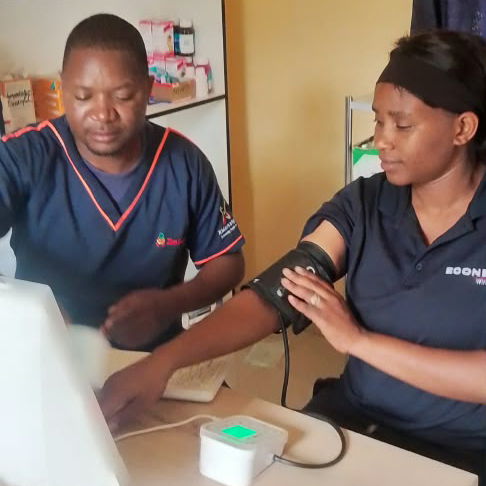 One photograph stands out to Admore when he reflects on the ZimSmart Villages journey.
It captures one of the venture’s early telehealth experiences in a repurposed post-office space. The founders had proposed converting underutilised post-office infrastructure into telehealth kiosks, but even they were uncertain whether communities would embrace the model and pay for services delivered this way.
Seeing a patient come in, receive a teleconsultation, access medication and later return changed that. For Admore, it was the moment an idea they had been testing became something tangible, providing evidence that the model could work in a real community.
Entrepreneurship has also brought unexpected moments. One of Admore’s most memorable came when he applied for a Virtual Care Leadership Award associated with the Middle East and North Africa region, despite being based in Zimbabwe. Several months later, he was selected as the 2025 winner and travelled to Saudi Arabia to receive the award. For Admore, the experience was a reminder not to rule yourself out before others have had the opportunity to consider what you have built.
Reaching more communities requires more than expanding ZimSmart Villages’ technology and services. It also requires an organisation capable of sustaining that growth. For Governance and Compliance Advisor Juliana Kariri, this means putting structures in place that allow the venture to grow without losing sight of the people it is designed to serve.
“My role as the governance and compliance advisor is to put in place systems, and not brakes,” she says. “Systems are the vehicle that keeps the project going forward.”
For Juliana, governance is therefore not separate from impact. The systems behind the organisation influence its ability to operate effectively, respond to growth and ultimately deliver healthcare consistently to the communities it serves. As ZimSmart Villages looks towards its next stage, strengthening those foundations will be important in moving from potential to sustainable impact at scale.
Working with Villgro Africa through The Fred Hollows Foundation Eye Health Accelerator gave the ZimSmart Villages team an opportunity to strengthen the business while reflecting more intentionally on its growth.
For Tawanda, the support has helped the team structure the business, strengthen its policies and systems, clarify different areas of operation and access mentors with experience relevant to the venture’s growth.
Admore describes the experience as a combination of “collaboration and action.” Being asked to examine indicators such as impact, revenue, partnerships and people reached has encouraged the team to reflect more deliberately on how it tracks its performance. He compares the process to looking in a mirror, helping the team recognise what is working and where more attention is needed.
For Juliana, one of the biggest takeaways was perspective. Beyond mentorship, she values having people who understand the journey and walk alongside the team as it grows. For her, the experience reinforced the importance of having the right systems, mindset and people in place, as well as the value of Ubuntu and learning together.
For ZimSmart Villages, the next chapter is about moving from potential to impact at scale. That will involve reaching more underserved communities while maintaining the quality of care and building a model that can sustain that growth. In the longer term, the ZimSmart founders see opportunities for solutions developed in Zimbabwe to reach communities more widely across Africa.
At the heart of that vision is a future where accessing healthcare is simpler, where people know where to turn when they need care and can connect to the right services without distance becoming a barrier.
As ZimSmart Villages looks ahead, the focus is on growing sustainably while staying responsive to the communities it serves. The ambition that has shaped the journey from the beginning remains unchanged: bringing healthcare closer to those who need it.